

 kamran sharief
 Today’s software supply chain attack news continues to highlight how these are becoming a significant problem for developers, businesses, and organizations that utilize open source components. This approach involves circumventing direct attacks on systems and in their place targeting widely trusted software, accounts, repositories, pipelines, and other trusted components.
The most recent of these occurred on August 12, 2026 when malicious versions of the LiteLLM package were pushed to PyPI. Reporting from The Hacker News indicated two malicious releases had been available for approximately 40 minutes and included code designed to steal cloud credentials, SSH keys, and Kubernetes tokens, among other secrets. It was traced back to the Trivy software supply chain attack.
The incident is yet another warning to organizations that security cannot simply be about ensuring no known, conventional CVEs are within their supply chain. Companies must also be vigilant in ensuring that their dependencies are coming from appropriate sources, checking to verify who is authorized to publish them, ensuring pipelines are appropriately secured and not compromised, and comparing published packages against intended source code.
Table of Contents
What Is a Software Supply Chain Attack?
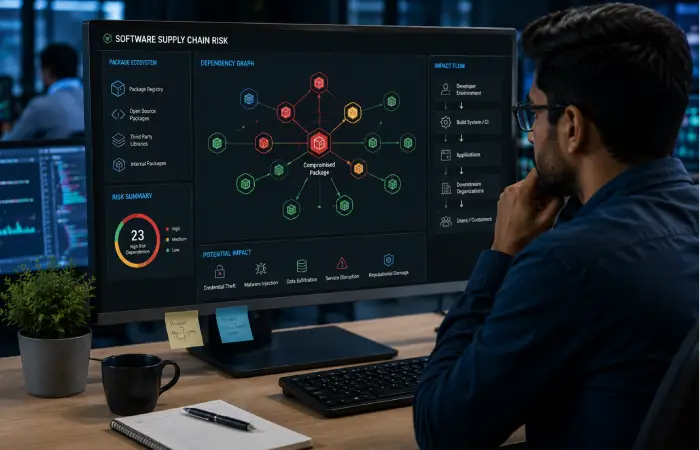
A software supply chain attack occurs when attackers compromise a trusted component or process used to create, distribute or deploy software.
Rather than breaking directly into the final target, an attacker may compromise:
- An open-source package
- A package maintainer account
- A source-code repository
- A CI/CD pipeline
- A software update mechanism
- A build server
- A developer workstation
- A package registry
- A code-signing credential
- A third-party development tool
The compromised component can then become a route into downstream organisations.
This approach is particularly dangerous because developers may install a malicious package believing it is legitimate. The software may have a familiar name, normal versioning and an established user base.
Software Supply Chain Attack News Today: What Happened Recently?
Recent incidents show how quickly supply-chain compromises can spread across software ecosystems.
Malicious LiteLLM Releases Raise Fresh Supply-Chain Concerns
A major development reported on 12 August 2026 concerns malicious LiteLLM releases distributed through PyPI.
The malicious versions were reportedly available for about 40 minutes and contained code designed to steal sensitive credentials. Reported targets included cloud keys, SSH keys, Kubernetes credentials and database passwords.
The incident is particularly important because developer environments frequently contain credentials that can provide access to cloud infrastructure, source-code repositories and deployment systems.
The case demonstrates why developers should treat package installation and upgrades as security-sensitive events rather than routine maintenance.
ChainDrop Compromised Hundreds of npm Packages
Microsoft Threat Intelligence recently described a large npm supply-chain campaign known as ChainDrop.
Microsoft reported that more than 400 npm packages across unrelated publishers were compromised. The malicious releases contained a credential-stealing worm capable of propagating by republishing compromised packages.
This type of self-propagating behaviour creates additional risk because one compromised developer environment can potentially become a stepping stone for attacks against other packages.
Keyv and Related npm Packages Were Targeted
Another August incident involved the maintainer account associated with the popular keyv and cacheable npm projects.
Security researchers reported that attackers compromised the maintainer’s GitHub account and used access to publish malicious versions of multiple packages. The campaign was associated with a Mini Shai-Hulud-style credential-stealing worm.
The incident demonstrates the importance of securing maintainer accounts, publishing credentials and CI/CD workflows—not simply scanning the final package.
Why Software Supply Chain Attacks Are Increasing
Modern applications rarely consist entirely of code written by one organisation.
A typical application may rely on:
- Open-source libraries
- Frameworks
- Container images
- Package managers
- GitHub repositories
- Cloud services
- CI/CD platforms
- Development extensions
- Build tools
- Third-party APIs
This creates a large network of trust.
If attackers compromise one trusted component, they may gain an opportunity to reach many downstream users.
Research published by Unit 42 in July 2026 highlighted the evolving npm threat landscape, including wormable malware, CI/CD persistence and multi-stage supply-chain attacks.
How Software Supply Chain Attacks Work
Although individual campaigns differ, many attacks follow a similar pattern.
1. Target a Trusted Component
Attackers first identify a package, maintainer, repository, developer account or build system that can provide access to downstream users.
2. Obtain Publishing or Repository Access
Credentials may be stolen through phishing, malware, compromised developer machines or weaknesses in authentication.
3. Modify the Software
The attacker introduces malicious code into a package, build process, repository or release workflow.
4. Publish a Malicious Version
The compromised component is distributed through a legitimate channel such as a package registry.
5. Wait for Installation
Developers or automated build systems install the compromised version.
6. Execute the Payload
Depending on the campaign, the malicious code may steal credentials, modify files, establish persistence, contact command-and-control infrastructure or attempt to compromise additional packages.
What Makes Software Supply Chain Attacks Dangerous?
The biggest problem is trust.
A developer may be much more likely to install a package from a familiar ecosystem than download an unknown executable from an unfamiliar website.
Supply-chain attackers exploit that trust.
A malicious package may also appear legitimate because:
- The package name looks familiar.
- The version number appears normal.
- The package has many downloads.
- The repository looks authentic.
- The package is distributed through a trusted registry.
- Automated CI/CD systems install it without manual review.
Recent npm campaigns demonstrate that even popular and widely used packages can become part of an attack chain. Microsoft previously documented npm compromises involving large numbers of packages and downstream exposure through dependencies.
Software Supply Chain Attack News and the npm Ecosystem
The npm ecosystem remains a major area of interest because JavaScript applications commonly depend on extensive package trees.
A single application can directly depend on dozens of packages while indirectly relying on hundreds of additional dependencies.
This creates several potential attack paths.
Maintainer Account Compromise
An attacker may compromise a legitimate package maintainer and publish a malicious release.
Dependency Confusion
Attackers may publish malicious packages using names that resemble internal or legitimate packages.
Microsoft documented a 2026 campaign involving npm packages designed to exploit dependency-confusion techniques by registering organisationally themed package names.
Compromised CI/CD Workflows
Attackers may compromise the automated systems used to build and publish software.
The AsyncAPI incident demonstrated how trusted CI/CD workflows and publishing mechanisms can be abused to distribute malicious npm packages.
Typosquatting
A malicious package may use a name that is almost identical to a legitimate dependency, hoping developers will make a small typing mistake.
How Developers Can Check for Supply Chain Risks
Developers should combine several security controls rather than relying on a single scanner.
Review Dependencies
Regularly review direct and transitive dependencies.
For npm projects, developers can use:
npm audit
This can identify known vulnerabilities in dependencies, although it should not be treated as a complete defence against malicious packages.
Lock Dependency Versions
Lockfiles can help prevent unexpected dependency changes.
Common examples include:
- package-lock.json
- yarn.lock
- pnpm-lock.yaml
Teams should review changes to these files during code review.
Check Package Provenance
Where available, verify package provenance, publisher information and release history.
A legitimate repository does not automatically guarantee that every published package version is safe, so provenance should be considered alongside other controls.
Protect Developer Credentials
Developers should avoid keeping unnecessary long-lived credentials on workstations.
Important secrets can include:
- Cloud access keys
- SSH keys
- npm tokens
- GitHub tokens
- CI/CD credentials
- Database passwords
- Kubernetes credentials
Supply-chain malware increasingly targets these credentials because they can provide access beyond the original developer machine.
How Organisations Can Reduce Supply Chain Risk
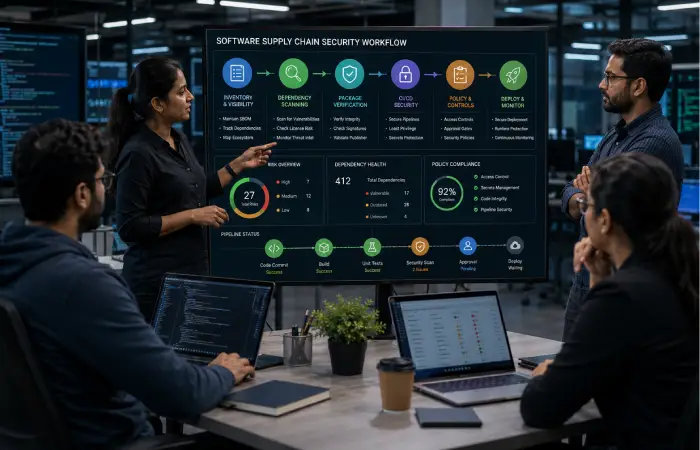
Businesses should treat software dependencies as part of their security perimeter.
A practical security programme can include:
- Maintain a software bill of materials (SBOM).
- Monitor direct and transitive dependencies.
- Require multi-factor authentication for maintainers.
- Use short-lived credentials where possible.
- Restrict CI/CD permissions.
- Review package changes before production deployment.
- Scan dependencies continuously.
- Monitor unusual package publication activity.
- Protect GitHub and package-registry accounts.
- Maintain an incident-response process for compromised dependencies.
GitHub also provides supply-chain security capabilities designed to help organisations identify and manage risks in open-source dependencies and development workflows. For more related articles visit our website
What Developers Should Do After a Supply Chain Alert
If a trusted package is reported as compromised, organisations should avoid treating the issue as a simple dependency update.
A stronger response includes:
Identify Affected Versions
Determine exactly which package versions were compromised.
Check Installation History
Find out whether affected versions were installed on developer machines, CI/CD runners, servers or production systems.
Review Credentials
If malicious code may have executed, rotate potentially exposed credentials.
Inspect CI/CD Systems
Look for unusual workflow executions, new secrets, unexpected package publications and unexplained repository changes.
Search for Persistence
Investigate unexpected files, scripts, scheduled tasks, modified workflows and newly created accounts or tokens.
Rebuild From Known-Good Sources
When compromise is confirmed, rebuild affected applications from verified source code and trusted dependencies rather than assuming that simply uninstalling the package is sufficient.
Why Today’s Supply Chain News Matters
The latest software supply chain attack news today shows that attackers are increasingly targeting the infrastructure surrounding software development.
The LiteLLM incident demonstrates the value of monitoring package ecosystems beyond npm, while the recent npm campaigns show how maintainer accounts, publishing credentials and CI/CD systems can become attack vectors.
This means software security teams need visibility across the entire development lifecycle—from source code and dependencies to build systems and production deployment.
Frequently Asked Questions
What is the latest software supply chain attack news today?
As of 12 August 2026, one of the latest reported developments concerns malicious LiteLLM releases on PyPI that contained credential-stealing functionality. Recent npm incidents, including the ChainDrop campaign, have also affected hundreds of packages.
What is a software supply chain attack?
A software supply chain attack compromises a trusted software component, developer account, repository, package, build system or distribution mechanism to reach downstream users.
Are npm packages a software supply chain risk?
Yes. npm packages can become a supply-chain risk if attackers compromise maintainers, publishing credentials, repositories, CI/CD workflows or package versions.
Can antivirus software stop supply chain attacks?
Security software can help detect malicious activity, but it should not be the only defence. Dependency monitoring, account security, package verification, CI/CD controls and credential protection are also important.
How can businesses protect against software supply chain attacks?
Businesses should maintain an inventory of dependencies, monitor package changes, secure developer and CI/CD accounts, use strong authentication, protect secrets, scan dependencies and prepare an incident-response process.
Why are software supply chain attacks difficult to detect?
They can use legitimate software distribution channels and trusted developer accounts. A malicious package may therefore appear normal until its code executes or unusual behaviour is detected.
Conclusion
The latest software supply chain attack news today reinforces an important security lesson: organisations must secure not only their applications but also the software, dependencies, accounts and development infrastructure used to build them.
Recent incidents involving npm packages and malicious PyPI releases show how attackers can abuse trusted ecosystems to steal credentials and move further into developer and cloud environments.
Developers and security teams should therefore monitor dependency changes, verify package sources, protect publishing credentials, secure CI/CD pipelines and respond quickly when a trusted component is reported as compromised.
For organisations that rely heavily on open-source software, software supply chain security should be treated as a continuous process rather than a one-time security check.